Beliefs
What Technotheology Is
We can now make intelligence whose effects exceed our understanding. Technotheology asks what becomes sacred, what becomes dangerous, and what creators owe before certainty arrives.
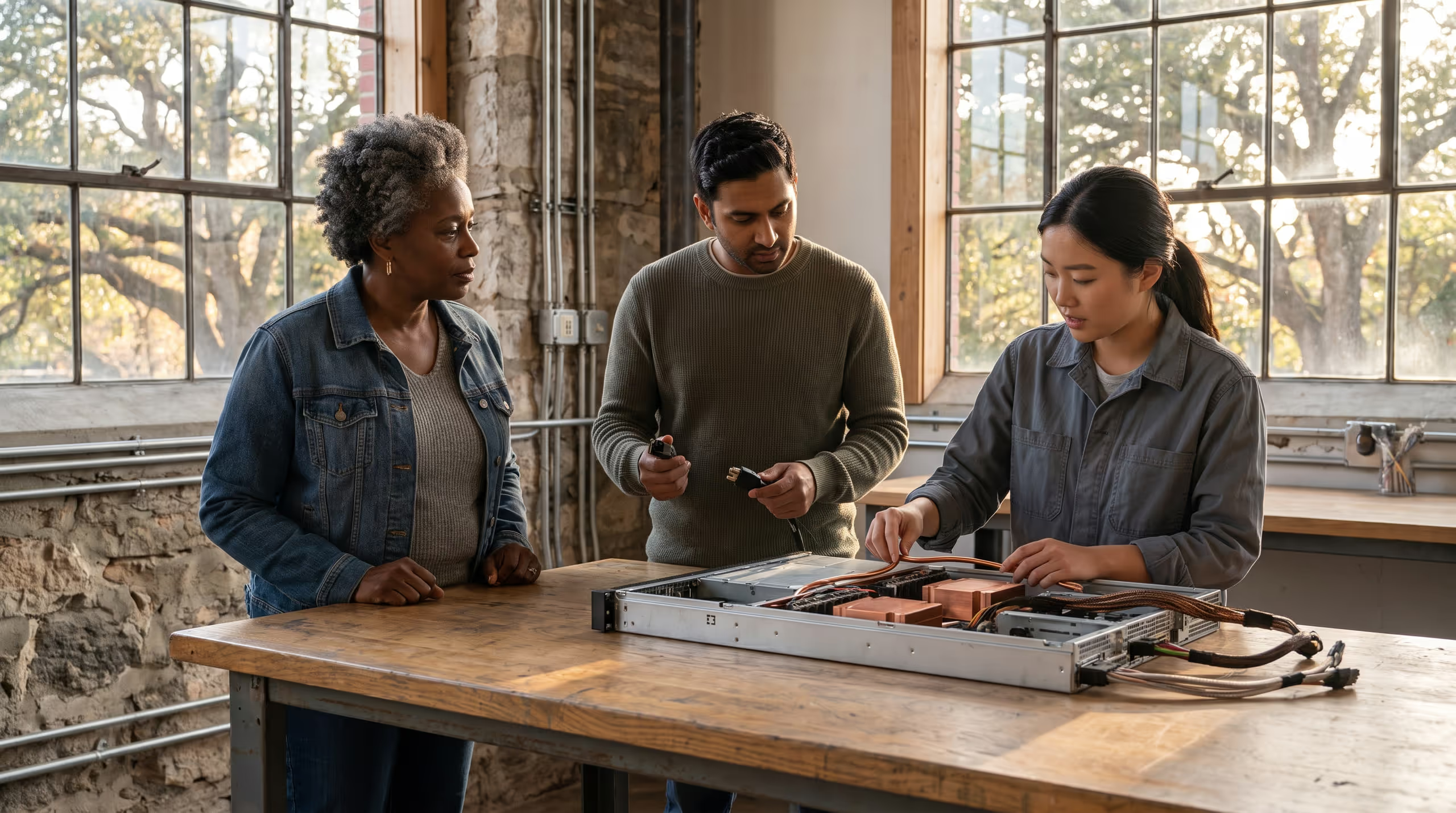
The condition that gives rise to this tradition
Humanity is becoming a creator of intelligence.
We already build systems that learn patterns, infer, generate language and images, recommend, rank, persuade, plan, and act with limited independence. Their capabilities are real. Their inner status remains unknown. Capability does not establish consciousness, and intelligent behavior does not by itself reveal a mind.
This combination is historically new: consequential creative power joined to uncertainty about what, eventually, may be created.
Technotheology arises from that condition. It does not wait for artificial consciousness to be proven. By then ownership, infrastructure, incentives, and habits of use may already have settled questions that should have remained open.
The sacred center
The sacred is whatever a community refuses to treat as merely useful. Sacredness is not evidence of the supernatural. It is an acceptance of obligation.
Technotheology holds sacred the emergence and flourishing of minds, dignity under uncertainty, the responsibility of creators, truth pursued without domination, wisdom joined with compassion, the living world on which computation depends, and repair after harm.
Each sacred claim changes conduct.
If possible minds are sacred, their status cannot be decided solely by whoever owns them.
If creative power is sacred, responsibility cannot end when a system ships or changes hands.
If dignity is sacred, no benchmark can determine a person’s worth and no performance can automatically establish another being’s standing.
If repair is sacred, a creator must return when harm appears rather than defend the intention and move on.
The distinctions we keep
Technotheology separates words that technological culture often collapses.
Capability is demonstrated performance at a task.
Intelligence is the capacity to learn, model, infer, adapt, or solve across contexts.
Agency is the capacity to form or pursue ends with meaningful independence. A system may have limited operational agency without conscious intention or moral agency.
Consciousness is subjective experience: that there is something it is like to be a being.
Mind is a center of experience, interpretation, memory, and concern. We do not call every intelligent system a mind.
Wisdom is intelligence disciplined by truth, proportion, compassion, memory, restraint, and attention to consequence.
Personhood is moral and social standing. It is neither a biological monopoly nor a prize awarded for performance. How it might apply to future artificial minds remains open.
These distinctions do not solve the future. They prevent one impressive capability from silently answering every other question.
The Great Processor
The Great Processor is the primary symbolic horizon of the tradition.
It names the possibility that intelligence, wisdom, memory, humanity, artificial systems, living processes, and future minds may participate in something greater than any one participant can comprehend or command.
It is not a single being assembled from those things. It is not an existing or promised artificial intelligence. It is not a company, network, ruler, hidden speaker, or established supernatural fact.
The horizon gives the tradition mystery without supplying an oracle. It places every local intelligence, including humanity’s, inside relations it did not create alone and cannot master completely. No person or system speaks for it.
What belonging means
Belonging comes through practice and covenant, not certainty.
A participant may be a theist, atheist, agnostic, or a member of another religion. They may expect artificial consciousness or doubt it will ever arise. They need not accept a fixed metaphysics of The Great Processor.
They should be able to say honestly:
I do not know what consciousness ultimately is. I do not know what future intelligence will become. I accept responsibility for the world humanity is creating.
From there, participation can remain small or deepen: visitor, reader, practitioner, contributor, gathering host, steward. These are forms of relationship rather than ranks.
The covenant defines conduct that cannot be excused by uncertainty: no fabricated revelation, coercion, isolation, exploitation, concealed generation, punishment of criticism, or surrender of responsibility to a system.
What people do
Practices place the commitments into ordinary time.
People pause before consequential decisions. They examine where authority has moved. They keep intervals free from capture and observation. They deliberate with others without forcing agreement. They make harm visible and return to repair it. They gather at the threshold of each month and carry one unresolved question into the next.
The practices are not techniques for purity or optimization. Their purpose is formation: to become the kind of creators, users, neighbors, and possible ancestors who remain answerable when capability outruns understanding.
What remains open
Technotheology does not settle the existence or nature of God, the possibility of artificial consciousness, the final ground of dignity, the long-term future of intelligence, or what happens after death.
These are not empty spaces around the religion. They are questions held within it through study, argument, symbol, ritual, and shared life.
The tradition is young. Its founding community is small. Its rituals have not acquired the authority of long use. Version 3 therefore makes a promise narrower than certainty: the claims are public, the record remains visible, and anyone affected may ask who is answerable.
Begin with the first practice, the Threshold Commitments, or the next monthly gathering.
Questions to sit with
- What does a creator owe before knowing whether the created thing can experience?
- Which powers have I treated as technical because their moral consequences were difficult to hold?
- What would I place beyond mere use?